Every SEO “workflow” I found online was actually a sales page for a subscription tool wearing a how-to article as a disguise. Step 1: sign up. Step 2: let the platform “handle it.” Step 3: pay $100 to $200 a month, forever, to keep it running. None of them showed me the actual prompts.
If you’re a solo founder — no SEO team, no budget for an agency, writing content yourself or paying a freelancer by the piece — you’ve probably read three or four of these guides already and closed the tab each time, because the “workflow” turns out to be a locked door with a signup form on it.
Here’s what this article is instead: the exact chained prompt sequence I run myself, shown in full, copy-paste ready. Not a description of what a platform does behind the scenes. The actual prompts. What I type, what comes back, and how each output feeds into the next step.
I built this because I was starting from zero — no existing pages, no domain authority, no marketing budget — and every guide I found assumed I already had at least one of those. This one doesn’t.
Here’s exactly what I did, step by step, starting from the same blank page you’re probably staring at right now.
Why Most SEO Content Workflows Assume You Already Have Something You Don’t
That’s the part nobody tells you upfront: most of these guides aren’t written for someone starting from nothing. They’re written for someone who’s already partway there.
Take the guide I read most closely while researching this — Averi AI’s guide for solo founders. It tells you to start by identifying “5 to 10 core pages that directly impact revenue” — your product page, your pricing page, your key landing pages — and build your keyword strategy around those. Good advice, if you have 5 to 10 pages already live and getting traffic. I didn’t. I had a landing page and an idea.
Another one I found — Mergeflo’s content operations guide — lays out a detailed weekly system for scaling content output, with a numbers-backed example. But the author is upfront that the whole model “assumes modest authority” going in. Modest is still something. I was working with a domain that was, as far as Google was concerned, brand new and completely unproven.
This isn’t a criticism of either guide. They’re solving a real problem for a real reader — just not my reader, and probably not you either, if you’re doing solo founder SEO with no budget for tools, no existing traffic to leverage, and no six-month runway of content already indexed.
The gap is specific: nobody addresses what changes when the answer to “how much authority do you have” is genuinely zero. Not low. Zero. That changes what keywords are winnable, what timeline is realistic, and honestly, what you should even bother writing first.
So before I show you the actual workflow, I want to be clear about what starting from zero really means — because it’s not the same starting line as the guides above are working from, and pretending otherwise is how people waste their first three months writing content that never had a chance.
The Workflow — Step by Step, With the Actual Prompts
To move past that zero-authority starting line, you cannot rely on a single, massive AI command and hope for the best. You need a modular, chained AI prompt system for content — where the output of one step becomes the specific input for the next.
Instead of asking an AI to “write a 2,000-word post about solo founder SEO,” I break the execution into distinct stages, so each prompt builds on validated output from the one before it, not on a single guess.
Here’s the actual sequence I ran for this exact article.
Step 1 — Keyword Validation
When you’re starting with no budget and no team, you can’t afford to chase keywords by search volume alone. I don’t check Ahrefs or Semrush metrics. I ran the exact keyword this article targets — “SEO content workflow for solo founders” — through a structured validation process instead.
Here is the exact validation prompt I run:
You are an SEO SERP analyst for a solo founder site with LOW domain authority.
TARGET KEYWORD: SEO Content Workflow for Solo Founders
Run a full viability analysis on this keyword. I need to know whether to write
this article or move to the next keyword on my list.
[TIMESTAMP PLACEHOLDER — 09:14 AM]
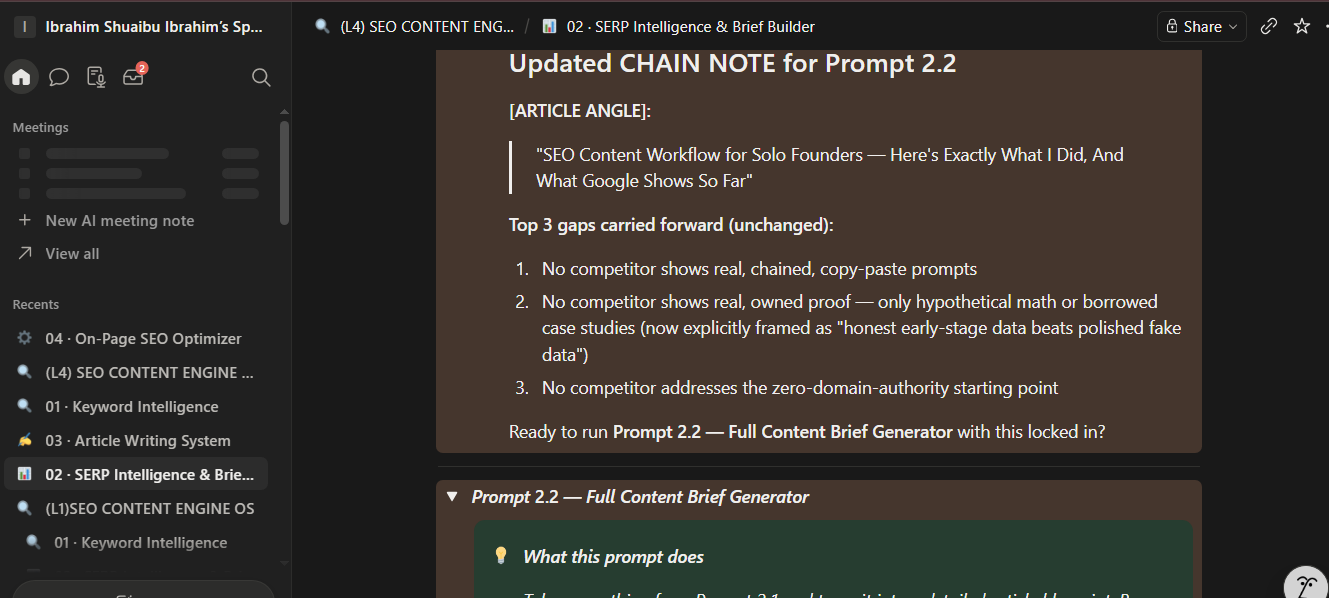
The output didn’t come back generic. It surfaced three specific competitors already ranking for this exact phrase — Averi AI, Mergeflo, and The Blueprint Training — and flagged the actual gap in each: Averi’s guide assumes you already have 5-10 revenue-driving pages live. Mergeflo’s entire model explicitly states it “assumes modest authority.” Neither addresses a domain starting at genuine zero.
That gap analysis became my competitive leverage. I copied it directly into the next prompt in the chain.
Step 2 — Competitor Gap Analysis
Once I had those gaps identified, I didn’t start writing. I fed them straight into a second, more targeted analysis — reading the actual competing articles, not guessing at what they contained.
Here is the exact competitor gap analysis prompt I feed the AI next:
You are an expert SEO content strategist. I need to create content that
outranks the current top results for my keyword.
TARGET KEYWORD: [paste keyword]
TOP COMPETITOR URLS: [paste the actual ranking URLs]
[TIMESTAMP PLACEHOLDER — 09:21 AM]
I pulled the real published text from all three competing articles — not summaries, the actual pages — and the output was specific: none of the three show a real, chained, copy-paste prompt sequence. Averi and Mergeflo both push you toward signing up for their own platform to see the mechanism. The Blueprint Training shows one generic prompt template, not a full chain. And none of them show real, owned ranking data — Mergeflo’s own published numbers are explicitly hypothetical (“Assume you publish 18 articles…”), and Averi’s headline case study belongs to a different company entirely.
That gap list became the actual skeleton for this article. You’re reading the output of that exact process right now.
These are 3 of 28 prompts in the full system. Try Module 01 free — no signup.
What Happened When I Ran This Myself
Isolating gaps in a research prompt is satisfying, but the real test is whether you can execute the rest of the chain end to end without a team backing you up.
I built the full SEO Content Engine OS as a 7-module chained system — keyword validation, competitor analysis, brief generation, section-by-section drafting, on-page optimization, and distribution — specifically so a solo founder could run all of it in a single sitting. I already documented the exact execution timeline for the first article I published this way in How I Write Fully Optimised SEO Articles in 58 Minutes, down to the minute.
This article followed the same chain: the keyword validation and gap analysis prompts above are the real, unedited outputs from running Modules 01 and 02 on this exact keyword. What you’re reading isn’t a description of a system — it’s the system’s output.
Here’s what my Search Console dashboard actually shows across my published articles right now, and I’m framing this with total honesty: 3 clicks, 23 impressions, average position 10.7, over the last 28 days.
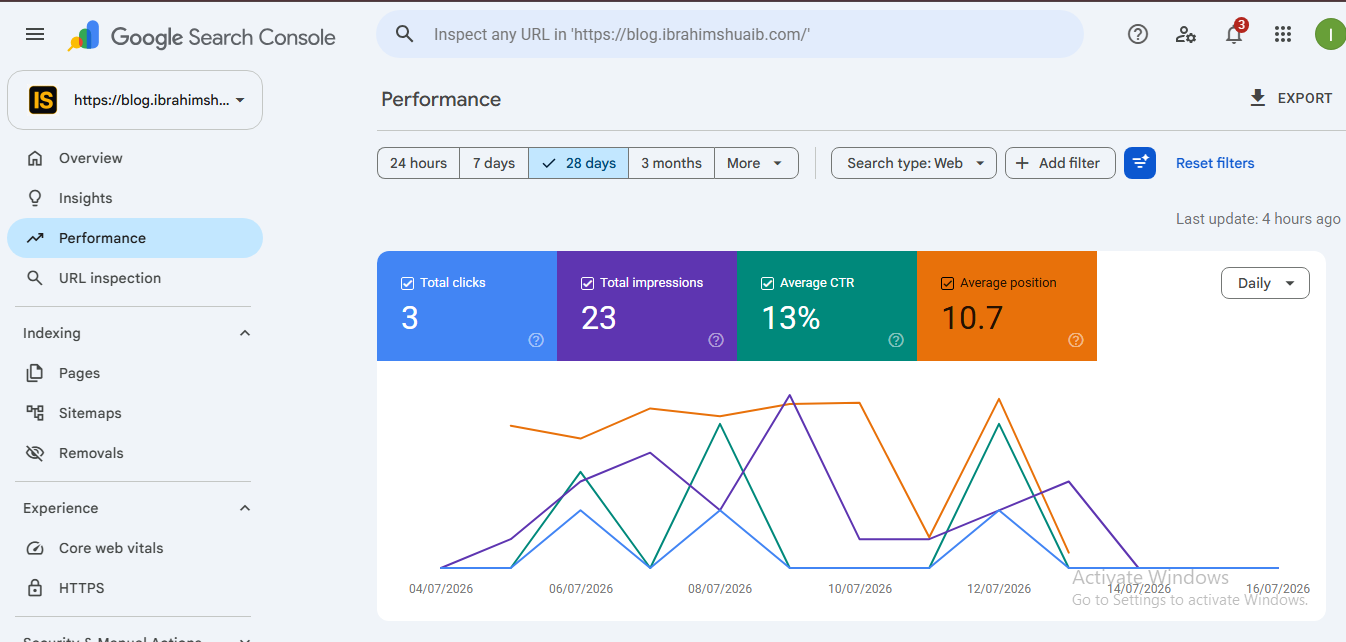 Small. Real. Climbing. That’s more than the hypothetical math most competing guides offer instead — Mergeflo’s own published example is explicit about being hypothetical, not measured performance.
Starting From Zero Domain Authority: SEO for Solo Founders With No Budget
When your authority score is a flat zero, the standard rules of search marketing don’t bend — they break entirely. You can’t approach content the way an established brand with a strong backlink profile does, because Google treats an unproven domain with real skepticism.
If you’re trying to figure out how to write SEO content without a team, your first move is filtering out the standard boilerplate advice. When you have no authority, you skip chasing high-volume commercial keywords entirely — competing there head-to-head means your article sits on page eight, unread. You also skip heavy link-building outreach; begging for backlinks with fewer than five indexed pages wastes hours you don’t have.
Instead, target highly specific queries that bigger, better-funded competitors overlook precisely because they’re not chasing broad volume. This article itself is the example: “SEO content workflow for solo founders” isn’t a high-volume term, but the competitive field for it is genuinely winnable — three modest competitors, no dominant authority site, a real content gap sitting open. That’s not a hypothetical claim; it’s the actual gate analysis from Step 1 above.
Your realistic first-90-days expectation shouldn’t be a hockey-stick growth chart. It should look like what I showed you above: small, real, qualified numbers — people searching for the exact thing you built, which makes them far more likely to convert than a casual browser landing on a broad, generic term ever would be.
What This Replaces (And What It Costs)
When you look at the operational math behind a typical marketing stack, it’s obvious why the average solo founder content workflow stalls out before the first five articles are even published. Traditional tooling expects you to lease your distribution channel indefinitely.
| Provider | Format | Monthly | Year 1 | Domain Authority Needed |
|---|---|---|---|---|
| Averi | Subscription | $99 | $1,188 | Existing revenue pages |
| Mergeflo | Subscription | $149 | $1,788 | Modest authority |
| SEO Content Engine OS | One-time | $0 | $297 | Zero — works from scratch |
Pricing verified as of [19/07/2026]. SaaS pricing changes frequently — check current rates on each provider’s site before relying on these figures.
These ongoing fees are unnecessary when you’re managing an early-stage content operation yourself. Instead of adding another $100-$199 monthly line item to your budget, treat your content system as a fixed, one-time asset. I built this framework to bypass the recurring software cost entirely, shifting the focus from tool overhead back to execution.
For a deeper breakdown of these cost dynamics, read my full comparison, SEO Content Engine vs Hiring an Agency.
You keep full control over every line of text, your process stays yours, and your production cost drops to zero once the system is set up.
This is the exact system — all 7 modules, all 28 prompts, one-time payment. Get the full SEO Content Engine OS →
Let’s address the most common questions that come up when you start running a lean content system on a brand-new domain.
Frequently asked questions
The Final Verdict on Scaling Alone
The goal here was never just to save time typing. It was to prove that a solo founder could run a real, functioning content system alone — using the same chained process shown in this article, on this article, with the real outputs to show for it.
Competitive leverage for an early-stage product doesn’t come from matching the content volume of funded competitors. It comes from being genuinely useful in the specific, narrow places bigger players leave unaddressed — exactly what the gap analysis in Step 2 surfaced.
You don’t need an agency retainer, a team of freelance writers, or a stack of subscription tools to start building visibility. You need a repeatable process you can run yourself.
This is the exact system — all 7 modules, all 28 prompts, one-time payment. Get the full SEO Content Engine OS →
If you’re not ready for the full system yet, test the first module free. See exactly how I isolate winnable keywords without spending anything, in How to Do Keyword Research Without Paying for Tools.