Why Solo Founders Build an SEO Content Engine vs Hiring an Agency to Scale Traffic
By Ibrahim Shuaib — Solo Founder, Nigeria. Builder of the SEO Content Engine OS™.

The Invisible Trap of Bootstrapped Search Strategy
I spent $18,000 on an SEO agency. Over six months. Before cancelling.
The agency was professional. The invoices were on time. The strategy decks were impressive. The traffic was forty-seven visitors a month.
That experience is what built the SEO Content Engine OS™ — and it is why I can answer the seo content engine vs hiring an agency question with more than an opinion. I have been on the wrong side of this decision with real money. Here is what I learned.
This guide breaks down both options honestly. Then it introduces a third path that most growth advice ignores entirely.
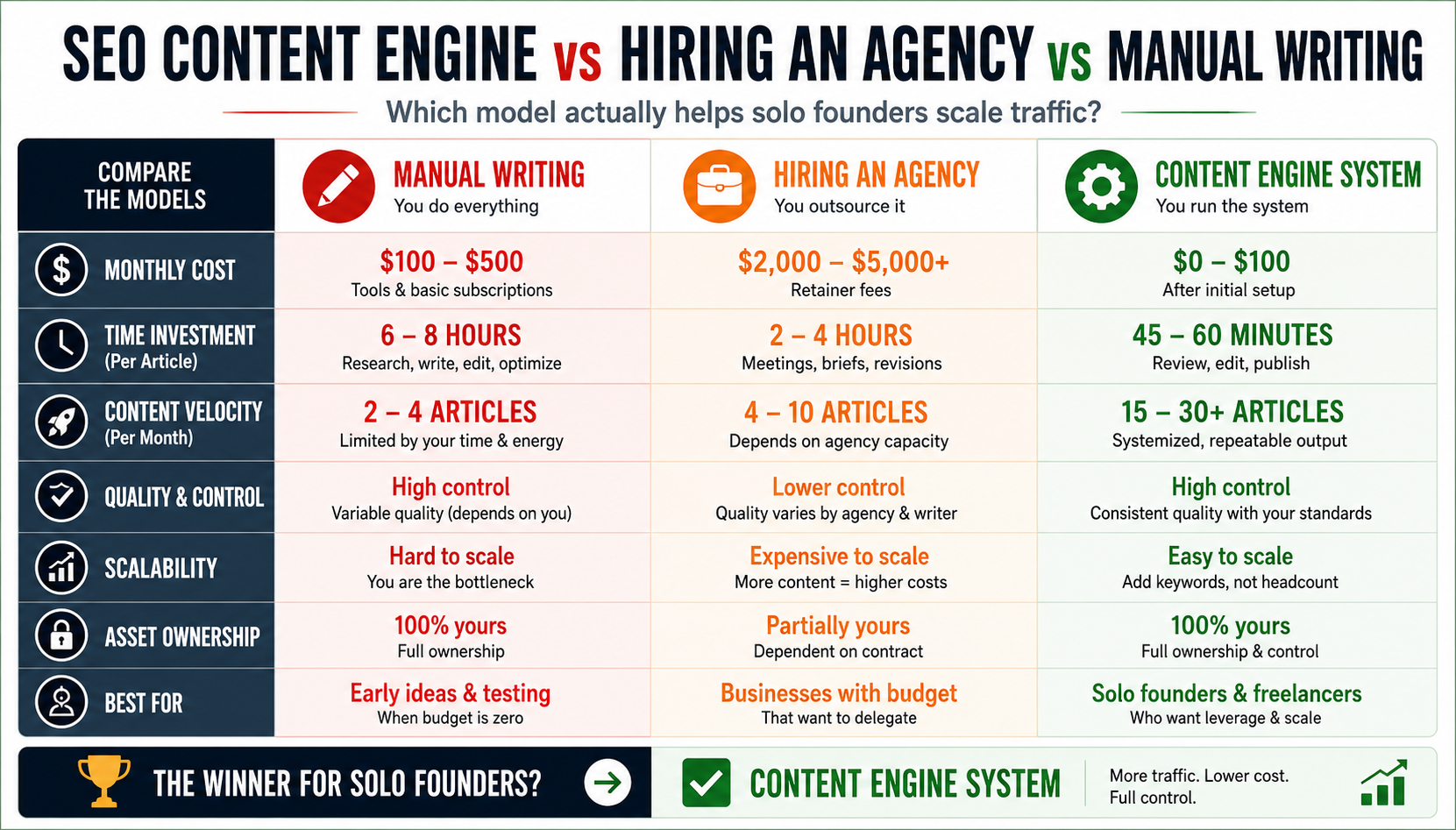
Is an SEO Content Engine Better Than Hiring an Agency for Solo Founders?
Most growth advice for founders presents two options. Write the content yourself or hire someone to do it. On a brand-new site with no domain authority, both of these paths break down fast.
The manual writing trap
When your site is new, Google treats it with skepticism. To earn trust you need to cover a topic in depth — not just one article but a full cluster of related content that signals genuine expertise in a specific area.
If you are writing everything yourself, your output is too slow to build that kind of coverage. Six hours per article means six hours you are not working on your product, talking to customers, or closing sales. For a solo operator that trade-off becomes unsustainable within weeks.
The freelancer trap
Many founders try to escape the time problem by hiring freelance writers. This rarely works at the early stage. Most marketplace writers look at the top three search results, rewrite what they find, and send it back to you. Google is specifically engineered to identify and filter this kind of content through its quality evaluations like Information Gain tracking.
You end up spending more time fixing bad drafts than it would have taken to write the piece yourself. And the drafts still do not rank because they contain no first-hand experience — which is exactly what Google’s quality systems are looking for.
Deconstructing the Invoice: Exposing the Agency “Account Management Tax”
Most founders assume a $3,000 monthly retainer buys $3,000 worth of content. It does not. Based on retainer contracts I have reviewed and industry data from platforms like Clutch.co, here is where a typical $3,000 agency retainer actually goes:
| Budget Line Item | Monthly Amount | Retainer % |
|---|---|---|
| Account management syncs and slide decks | $900 | 30% |
| Executive strategy briefings | $600 | 20% |
| Software overhead and licensing fees | $450 | 15% |
| Actual strategic content writing | $1,050 | 35% |
That means 65% of your budget — $1,950 — pays for meetings, slide decks, and software the agency needs to run its own business. Not yours.
Your $3,000 buys $1,050 worth of actual content. And that content is usually written by a junior writer or an outsourced contractor — not the senior strategist who pitched you on the call. For a bootstrapped solo founder this is not a growth strategy. It is a slow drain on your runway before your site ever gains traction.
The Tech Stack Fallacy: Dismantling the Mandatory $500/mo Tool Suite
Agencies justify their fees by pointing to expensive software. SEO tool companies spend millions convincing you that a $150 to $200 monthly subscription is the only way to do keyword research. This is a manufactured dependency.
These tools pull information from public sources, package it, and charge you a monthly fee to see it. They also give new sites misleading signals — a keyword difficulty score tells you the average domain authority of pages currently ranking, not whether your specific site can actually displace them.
Your buyers are telling you exactly what they need — in Google autocomplete suggestions, in Reddit threads, and in forum posts. You can build an entire content roadmap using keyword research without paying for tools entirely for free.
Put that $500 back into your runway. Spend the time on your system instead. The founders doing this well are replacing SaaS bloat entirely with the best AI prompt system for indie hackers — deploying deterministic, highly curated input-output models directly inside their baseline productivity environments.
(Want to test this workflow before committing capital? The free keyword research tool at tool.ibrahimshuaib.com runs on Module 01 of the full system — no signup, no email, results in 60 seconds.)
The Third Path: Building Your Own Content Engine
This is the option the seo content engine vs hiring an agency debate almost never mentions. It is the only model that solves the cost problem and the time problem simultaneously.
A content engine is not a collection of generic AI prompts. It is a structured system where each step produces an output that feeds directly into the next. You run keyword research first. That output shapes your article brief. The brief shapes how each section is written. Each section is written separately rather than in one long unfocused prompt. Then you run an SEO audit on the finished draft before publishing.
The result: a fully optimised article in about 60 minutes. Not six hours. Not a $3,000 invoice.
What changes for you
When you use this kind of system your role changes. You are no longer sitting at a blank document trying to write 2,000 words from scratch. You are making decisions and checking outputs. You move from a manual writer paradigm to a systems editor paradigm. That timeline compression isn’t theoretical; it is a proven framework that allows independent operators to maintain massive publishing volume, as detailed in our blueprint detailing how I write SEO articles in 58 minutes.
When you deploy a production-grade AI content writing template for solo founders, you are not creating prose from a blank canvas. You are managing an internal production infrastructure. Your only job is to feed the engine your unique product expertise, ensure the output hits your validation benchmarks, and push optimized assets live at a velocity that legacy agencies cannot duplicate.
Ready to stop paying the agency overhead tax? The SEO Content Engine OS™ is a 7-module, 28-prompt Notion system that takes solo founders from keyword research to published, optimised article in 60 minutes. One payment. No retainer. No ongoing cost. Deploy your engine → ibrahimshuaib.com
Why Prompt Chains Beat Both Agencies and Standalone AI Tools
There is one important distinction to understand before you build your own engine: the fundamental difference between AI prompt chains vs programmatic SEO tools and single-shot configurations.
When you ask an AI to write a complete 2,000-word article in one prompt, two things happen. First, the output is generic — the AI has no specific brief to work from so it covers the same ground as every other article on the topic. Second, quality drops significantly after the first few hundred words as the model loses focus due to context drift.
A prompt chain solves both problems. Each prompt has a specific job: one defines the keyword and intent, the next analyses competitor gaps, the next builds the article brief, then each body section is written separately with the previous section passed in as context layers.
The result is an article that covers gaps the competition misses — because the research phase ran before any writing began — and maintains consistent quality throughout because each section is generated with fresh focus. This is why building your own system produces better results than any subscription tool with a single generate button. The tool automates the writing. The system automates the thinking that makes the writing rankable.
Operational Layout: Running Your Engine Inside a Single Workspace
The second operational problem most solo founders hit when they start building a content system is fragmentation. Keyword research lives in one spreadsheet. Drafts live in a different folder. Briefs are in email threads or scattered notes.
When your content architecture is decentralised you waste significant time every article cycle just moving information between tools. The system slows down and eventually stops because the friction is too high.
The solution is a single workspace — one place that connects your keyword list to your brief, your brief to your draft, and your draft to your publishing checklist.
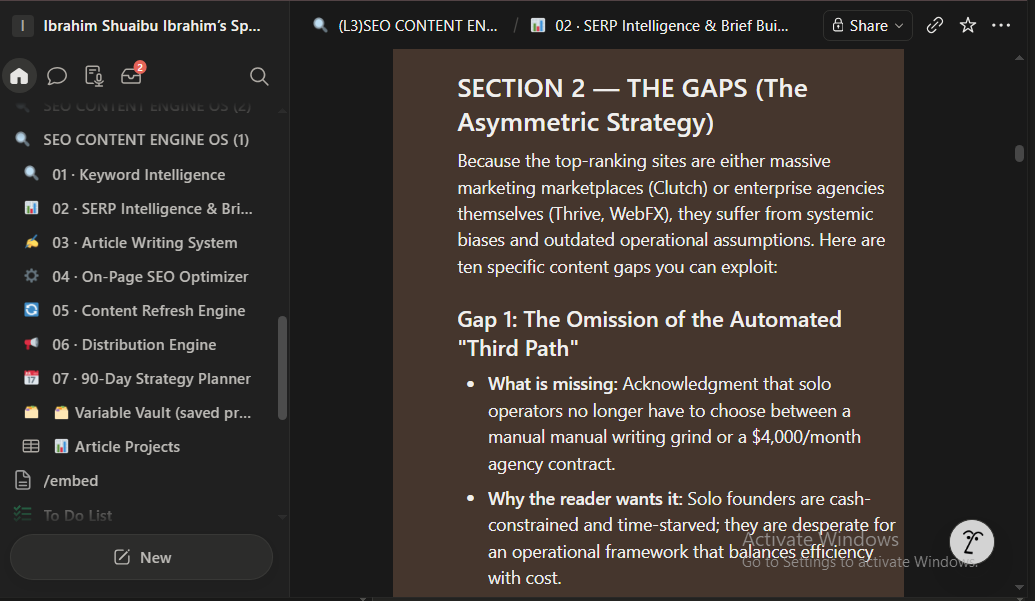
This is exactly why a structured Notion SEO template for freelancers and independent builders provides a far clearer operating interface than a complex enterprise project tracker. The SEO Content Engine OS™ is built inside Notion because a relational workspace houses the keyword database, the prompt sequence, the draft output, and the publishing checklist in one connected dashboard. You open one thing, run the system, publish, and close it.
One founder with one workspace can maintain the publication velocity that most agency clients are paying $3,000 a month to achieve.
The Ownership Question
The seo content engine vs hiring an agency question is ultimately a question about ownership.
When you hire an agency you rent access to a production process. The moment the retainer stops, the content stops. The rankings that were building stall because Google rewards consistent publishing from sites with topical depth — and a stopped publication schedule signals to Google that the site is no longer actively maintained. The knowledge of your niche and your audience that the agency accumulated walks out the door. Momentum built over months can decay significantly within 60 to 90 days of stopping.
When you build your own system you own it permanently. It runs every time you open it. The articles compound. The rankings compound. The cost per published article drops every month because the system cost is fixed at one payment.
Your content infrastructure should be as owned and as permanent as your product. Stop renting. Start building.
Deploy the SEO Content Engine OS™ → ibrahimshuaib.com
Not ready for the full system yet? Start with the free keyword tool: tool.ibrahimshuaib.com — no signup, 20 keywords in 60 seconds.
About the Author
Ibrahim Shuaib is a solo founder from Lagos, Nigeria and the builder of the SEO Content Engine OS™ — a 7-module, 28-prompt Notion system that takes solo founders from keyword research to published, optimised article in 60 minutes. He built this system after spending $18,000 on agency retainers that produced zero rankings. Follow on X and LinkedIn.
Frequently Asked Questions
How do solo founders do SEO without an agency?
Solo founders succeed at SEO without an agency by replacing manual writing and expensive retainers with a structured prompt system that handles keyword research, content briefs, and article sections in sequence. Each step feeds the next, compressing a standard six-hour production cycle into under 60 minutes. The key is owning the system rather than renting access to one.
Can you rank an article written with AI prompts?
Yes — if the article is built with a structured chained system rather than a single generic prompt. Google rewards helpful, expert content regardless of how it was produced. Single-shot prompts generate generic text that mirrors existing results and fails to rank. Connected prompt chains that run competitor analysis before writing and integrate real first-hand experience satisfy search intent and Google’s quality standards.
What is the fastest way to write an SEO blog post?
Break the article into separate tasks and handle each one with a focused prompt — keyword research first, then competitor gap analysis, then the article brief, then each body section individually, then an SEO audit on the finished draft. Most founders running this sequence complete a fully optimised article in under 60 minutes. Writing the whole article in one prompt is slower because the output requires extensive editing to be usable.
What is the best SEO workflow for a team of one?
Keep everything in one workspace — a single connected dashboard that links your keyword list to your brief, your brief to your draft, and your draft to your publishing checklist. Fragmented tools that require you to move information between spreadsheets, document folders, and separate apps create friction that slows production and eventually causes the system to stop. One workspace, one source of truth, one repeatable sequence.
How do you ensure AI-assisted content meets Google’s quality guidelines?
Google cares about whether your content is helpful and demonstrates genuine expertise — not how it was produced. A well-built prompt system forces quality by requiring competitor gap analysis before writing, your first-hand experience and specific data points woven into each section, and a structured SEO audit before publishing. Generic AI output fails because it skips the research phase. Structured AI output that starts with research consistently meets Google’s helpful content standards.
Is a $297 content system worth it versus a $3,000 agency retainer?
Yes. A $3,000 agency retainer produces approximately $1,050 of actual content after overhead costs. A $297 one-time system produces as many articles as you publish, permanently, at zero additional cost per piece. The break-even point is the first article. Every article after that is pure margin in favour of the system.
What happens to my SEO when I stop paying an agency?
Content production stops immediately. Any rankings that were building stall because Google rewards consistent publishing from sites with topical depth — and a stopped publication schedule signals to Google that the site is no longer actively maintained. Momentum built over months can decay significantly within 60 to 90 days of stopping. Owning your own system means this risk disappears entirely — the system runs whenever you run it, indefinitely.